
ELIE WIESEL
On December 10, 1986, Nobel Peace Prize laureate, author, teacher, humanitarian and Holocaust survivor Elie Wiesel framed his Nobel acceptance speech, “Hope, Despair and Memory,” with this quote:
“Remembering is a noble and necessary act. The call of memory, the call to memory, reaches us from the very dawn of history.”
Memory is a fragile enterprise. If revisited and replayed with clear eyes and heart, our memories can incite joy and solace or propel us to acknowledge pain from our past and revive our better angels.
“Elie Wiesel was born on the 30th of September 1928 in the Romanian town of Sighet in the Carpathians. He and his three sisters grew up in a peaceful family which was strongly bound by Jewish traditions and the Jewish religion,” recalled Egil Aarvik, Chairman of the Norwegian Nobel Committee in December 1986. “Elie was 14 years old when the deportation of Hungarian Jews began. Sighet was occupied by Hungary, and the town’s Jewish population was packed, in the usual humiliating way, into goods wagons and transported to Auschwitz. There he saw his mother and youngest sister sent to the gas chambers. Later, his father died while being transported to Buchenwald.”
Elie Wiesel could easily have been forgiven if he moved on with his life and allowed the memory of his horrific childhood to fade into oblivion. But instead of being consumed by grief and despair or driven by revenge and retribution, his memories catapulted him onto the world stage as a prolific lecturer, memoirist and author (57 books!), longtime professor at Boston University, and human rights advocate. He was awarded the Nobel Peace Prize in 1986. He lived to tell his story in the hopes that it would imprint on the collective memory of present and future generations, so that the atrocities that he experienced firsthand could never happen again.
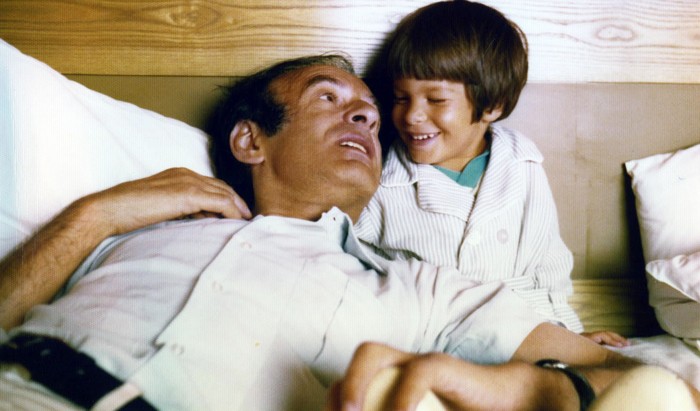
Elie Wiesel and his son Elisha Wiesel.
His backstory, his lifelong advocacy for human rights and, most importantly, his voice are the threads that flow through the 90-minute American Masters profile, Elie Wiesel: Soul on Fire, premiering on PBS tonight, Tuesday, January 27, 2026, 9:00 – 10:30 p.m. ET. (Check local listings for air times and repeat broadcasts in your region.)
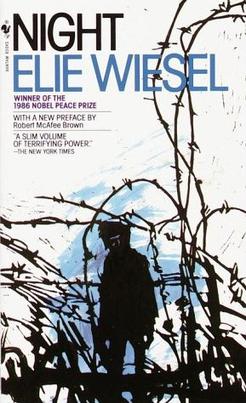
Elie Wiesel: Soul on Fire, written, produced and directed by Oren Rudavsky, taps Wiesel’s voice as narrative via vintage audio and film footage enhanced by on-camera interviews with his wife and son, various colleagues and former students and current Holocaust educators. While the use of expressionistic animation by Joel Orloff to illustrate Wiesel’s agonized backstory is a tad excessive and intrusive, and the film as a whole is standard documentary fare, a brief sequence focusing on a middle school classroom at the Northstar Academy in Newark, NJ, is a revelation and cries out for additional coverage and discussion. The students are clearly gifted as is their teacher, Paris Murray. As Ms. Murray introduces her class to Wiesel’s remarkable memoir, Night (1960), we see a wonderful example of Elie Wiesel’s life’s work play out in real time. He would be so proud!
The film’s timely debut commemorates 2026 International Holocaust Remembrance Day. It will stream concurrent with broadcast on all station-branded PBS platforms, including http://PBS.org and the PBS App, available on iOS, Android, Roku streaming devices, Apple TV, Android TV, Amazon Fire TV, Samsung Smart TV, Chromecast and VIZIO. For more information on Elie Wiesel: Soul on Fire and other films in the American Masters PBS series, check out http://pbs.org/americanmasters
 I never met Elie Wiesel, but I have the distinct memory of having spoken with him…on the phone. It may not sound like much, but to me, it was thrilling. During my tenure as Director of The Christopher Awards, a decades long national Awards program annually honoring books for adults and children, films and TV programs and individuals whose life’s work “affirmed the highest values of the human spirit,” I was determined that our annual Awards gala presenters be past Christopher Award winners.
Thankfully, with that goal in mind, I was able to corral a stellar group of presenters from the film, TV and publishing industries each year to present our Awards. Elie Wiesel was a previous honoree decades before I joined the Christophers… a man I revered, who I knew would inspire our gala attendees and current winners with a stirring speech that would live on in their collective memories. Sadly for me and our gala audiences, he was so booked up with lecture engagements that our schedules never meshed. Elie Wiesel passed away on July 2, 2016 at the age of 87.
On December 10, 1986, Elie Wiesel received the Nobel Peace Prize in Oslo, Norway, an honoree who “dedicated his life and writing to the themes of memory, the dangers of indifference, and the moral duty to act against injustice.” I have reprinted below and encourage you to read excerpts from the Presentation speech made that day regarding Elie Wiesel’s stellar qualifications for the Prize. I do this with the hope that it will not only remind us of the urgent work that needs to be done to reverse growing antisemitism and racism in our country and the erosion of our Democracy and disregard for our Constitution, but also will clarify the actual criteria for Nobel Peace Prize consideration. –Judith Trojan
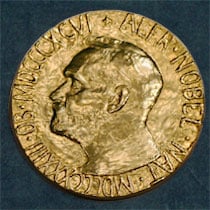
Excerpts from the Presentation Speech delivered on December 10, 1986, honoring Nobel Peace Prize laureate Elie Wiesel, by Egil Aarvik, Chairman of the Norwegian Nobel Committee
“Most people were unable to recognise the deadly threat to democracy which was developing. During Nazism’s formative years the general attitude was one of unsuspicious ambivalence. Of course one disagreed with Hitler, but when is one not in disagreement with politicians? And of course one was aware of the terrible rumours about the brownshirts’ atrocities, but wasn’t it necessary to evaluate this against the background of the extraordinary situation in the country? At least there was now a strong and active government, and Hitler was of course a democratically elected leader… Most people feared some sort of unavoidable catastrophe. But only a few suspected the extent of what was happening – and it is precisely because of this blindness that the catastrophe was allowed to happen.
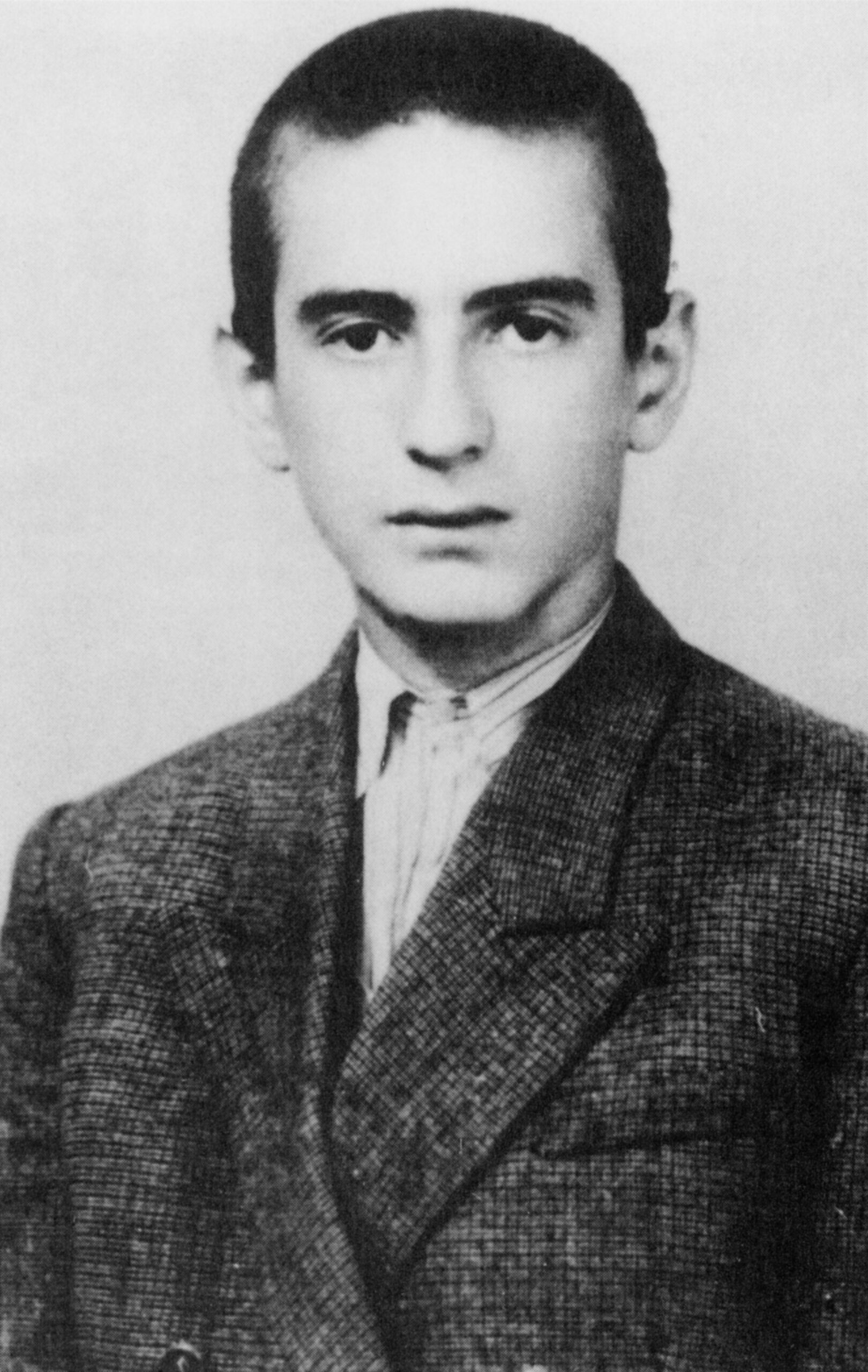
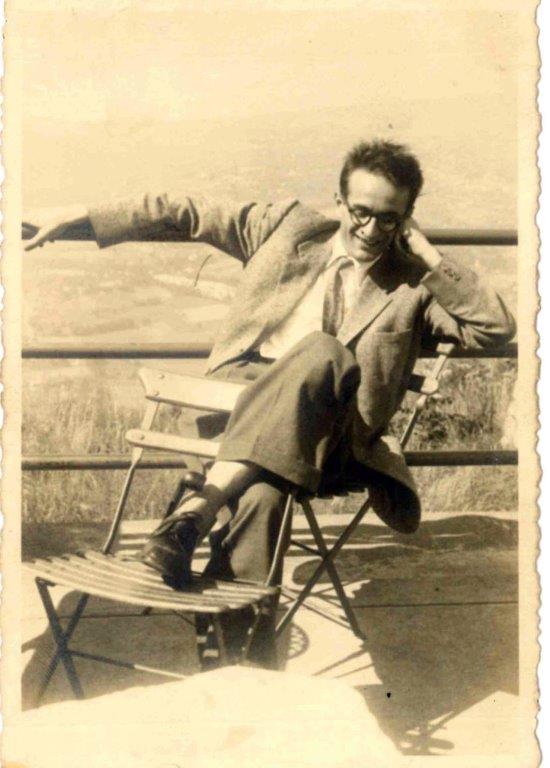
Young Elie Wiesel.
“Today, the Peace Prize is to be presented to one who survived. In 1945, on the ashes left behind after the sacrificial flames which annihilated six million Jews, sat the 17-year-old Elie Wiesel, an only son of Abraham, an Isaac who once again had escaped a sacrificial death on Mount Moriah at the last moment. He will receive the Nobel Peace Prize today because he, too, has become a witness for truth and justice. From the abyss of the death camps he has come as a messenger to mankind – not with a message of hate and revenge, but with one of brotherhood and atonement. He has become a powerful spokesman for the view of mankind and the unlimited humanity which is, at all times, the basis of a lasting peace. Elie Wiesel is not only the man who survived – he is also the spirit which has conquered. In him we see a man who has climbed from utter humiliation to become one of our most important spiritual leaders and guides.
“The Nobel Committee believes it is vital that we have such guides in an age when terror, repression, and racial discrimination still exist in the world.
“Through his books Elie Wiesel has given us not only an eyewitness account of what happened, but also an analysis of the evil powers which lay behind the events. His main concern is the question of what measures we can take to prevent a recurrence of these events.
“It is this that Elie Wiesel wants us to understand. His mission is not to gain the world’s sympathy for the victims or the survivors. His aim is to awaken our conscience. Our indifference to evil makes us partners in the crime. That is the reason for his attack on indifference and his insistence on measures aimed at preventing a new holocaust. We know that the unimaginable has happened. What are we doing now to prevent it happening again? Do not forget, do not sink into a new blind indifference, but involve yourselves in truth and justice, in human dignity, freedom, and atonement. That is this Peace Prize laureate’s message to us.
“It has been said that peoples or cultures who forget their history are doomed to repeat it, and it is against the background of his own experiences that Elie Wiesel now warns us of this.
“The duty and responsibility which Elie Wiesel preaches are not primarily concerned with the fear of the terrors of the past repeating themselves. It is much more an engagement directed at preventing the possible victory of evil forces in the future. The creative force in this process is not hate and revenge, but rather a longing for freedom, a love of life and a respect for human dignity. Or as Elie Wiesel has said himself: ‘I will conquer our murderers by attempting to reconstruct what they destroyed.’
“Elie Wiesel sat thus in the ashes after Auschwitz. The storm and fire had terrorized his life. Everything was in ruins. His family was annihilated. Two of his sisters were alive, though he was not aware of this at the time. He was homeless and without a fatherland. Even his identity as a human being was undermined – he was now prisoner number A 7713, a sort of shipwrecked sailor on a burnt coast, without hope, without a future. Only the naked memories remained. Why did this have to happen? And why should I have survived? Dear God, why were six million of your own chosen people sent to their deaths? Where were you when they hanged 12 year olds in Auschwitz, or burned small children alive in Birkenau?
“But he was alive. And in time it occurred to him that there could be a purpose behind it – that he was to be a witness, the one who would pass on the account of what had happened so that the dead would not have died in vain and so that the living could learn.
“All Elie Wiesel’s books and publications are concerned with the same theme – the Holocaust is present in them all. As he himself says: ‘You can get out of Auschwitz, but Auschwitz can never get out of you.’ But, even though the theme is always the same, and even though the same story is repeated time after time, there is always a new approach which opens up new perspectives. There is a remarkable development in Wiesel’s authorship.
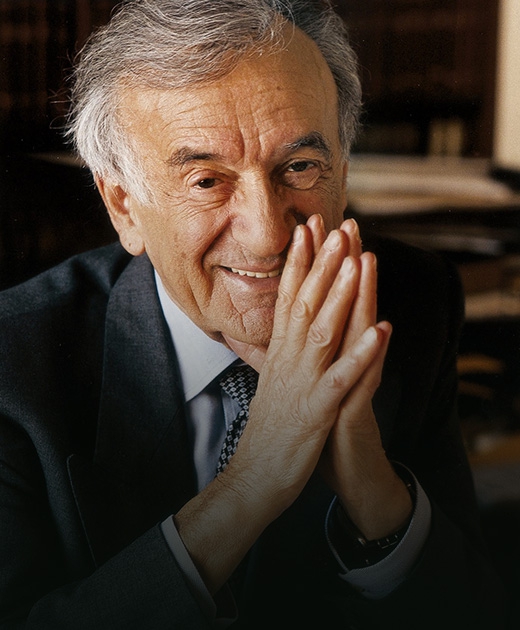
Nobel Peace Prize Laureate Elie Wiesel.
“It is in recognition of this particular human spirit’s victory over the powers of death and degradation, and as a support to the rebellion of good against the evil in the world, that the Norwegian Nobel Committee today presents the Nobel Peace Prize to Elie Wiesel. We do this on behalf of millions – from all peoples and races. We do it in deep reverence for the memory of the dead, but also with the deep felt hope that the prize will be a small contribution which will forward the cause which is the greatest of all humanity’s concerns – the cause of peace.” Copyright © The Nobel Foundation 1986
Discover more from FrontRowCenter
Subscribe to get the latest posts sent to your email.


 FrontRowCenter
Wonderful piece, Judy. Well done.
LikeLiked by 1 person
Thank you! Much appreciated!
LikeLike