
“This is the story of the most curious man in history.”
 Painter, draftsman, writer, designer, architect, inventor, philosopher, scientist, mathematician, military and aeronautical engineer, philosopher, cartographer, geologist, botanist, anatomist, physicist. Clearly, there was more to the man than the “Mona Lisa” and “The Last Supper.”
Leonardo da Vinci (1452-1519) embraced an exhaustive aggregate of vocations and avocations, filling thousands of notebook pages with exploratory drawings and profound musings that were often centuries ahead of the curve during his 15th and 16th century lifetime.
Leonardo da Vinci would be a daunting subject for any filmmaker, and seemingly beyond the purview of Ken Burns, who has spent his entire career filming Award-winning documentaries about American history. It’s no surprise that noted historian Stephen E. Ambrose (Band of Brothers) once said of Burns, “More Americans get their history from Ken Burns than any other source.” So why Leonardo da Vinci, and why now?
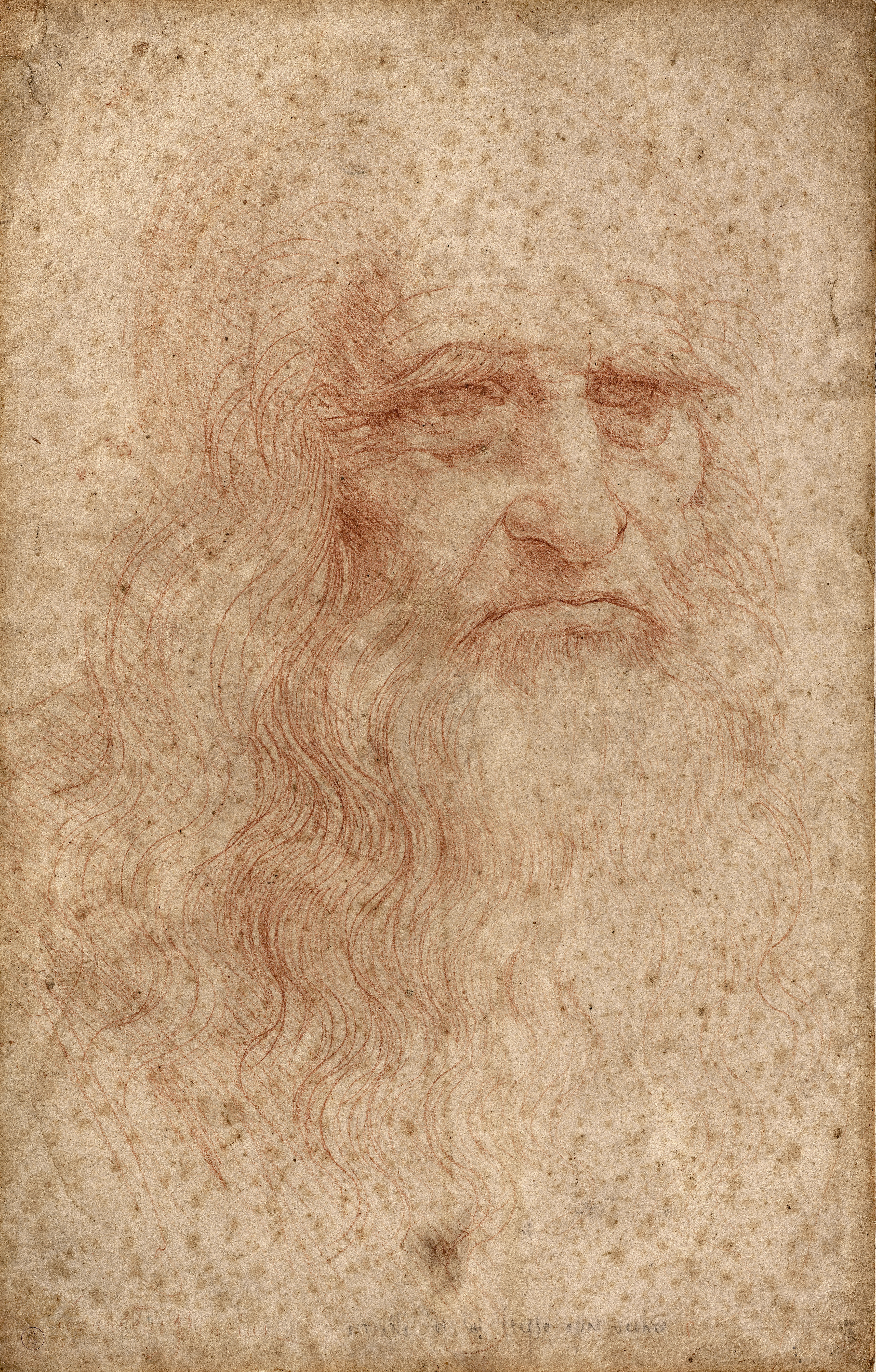
LEONARDO DA VINCI (1452-1519). Self-portrait (Red chalk on white paper), circa 1515.
“No single person can speak to our collective effort to understand the world and ourselves,” said Ken Burns. “But Leonardo had a unique genius for inquiry, aided by his extraordinary skills as an artist and scientist, that helps us better understand the natural world that we are part of and to appreciate more fully what it means to be alive and human.”
Perhaps the leap to Leonardo was not such a stretch for Burns after all, given that Leonardo shares some common ground with visionary American polymath Ben Franklin. You can read my coverage of Burns’ riveting four hour, 2022 documentary, Benjamin Franklin, here @ http://www.judithtrojan.com/2022/04/04).
Lucky for us that it was time for Burns to turn his camera on foreign shores and collaborate once again with his director/writer daughter Sarah Burns (The Central Park Five), and her writer/director husband David McMahon on their extraordinary, new two-part, four hour documentary, Leonardo da Vinci, set to debut on PBS tonight, Monday, November 18, 2024, and tomorrow, Tuesday, November 19, 2024, 8:00 – 10:00 p.m. ET/ 7:00 C each night. (Check local listings for air dates in your region and below for complete details.)
Let me just say from the outset that during the four hours that I spent screening Leonardo da Vinci, words like “Wow“…”Brilliant“…”Extraordinary” and “Breathtaking” popped out of my mouth and landed squarely on the pages of my handwritten notes. If you think you already know everything you need to know about Leonardo da Vinci, think again.
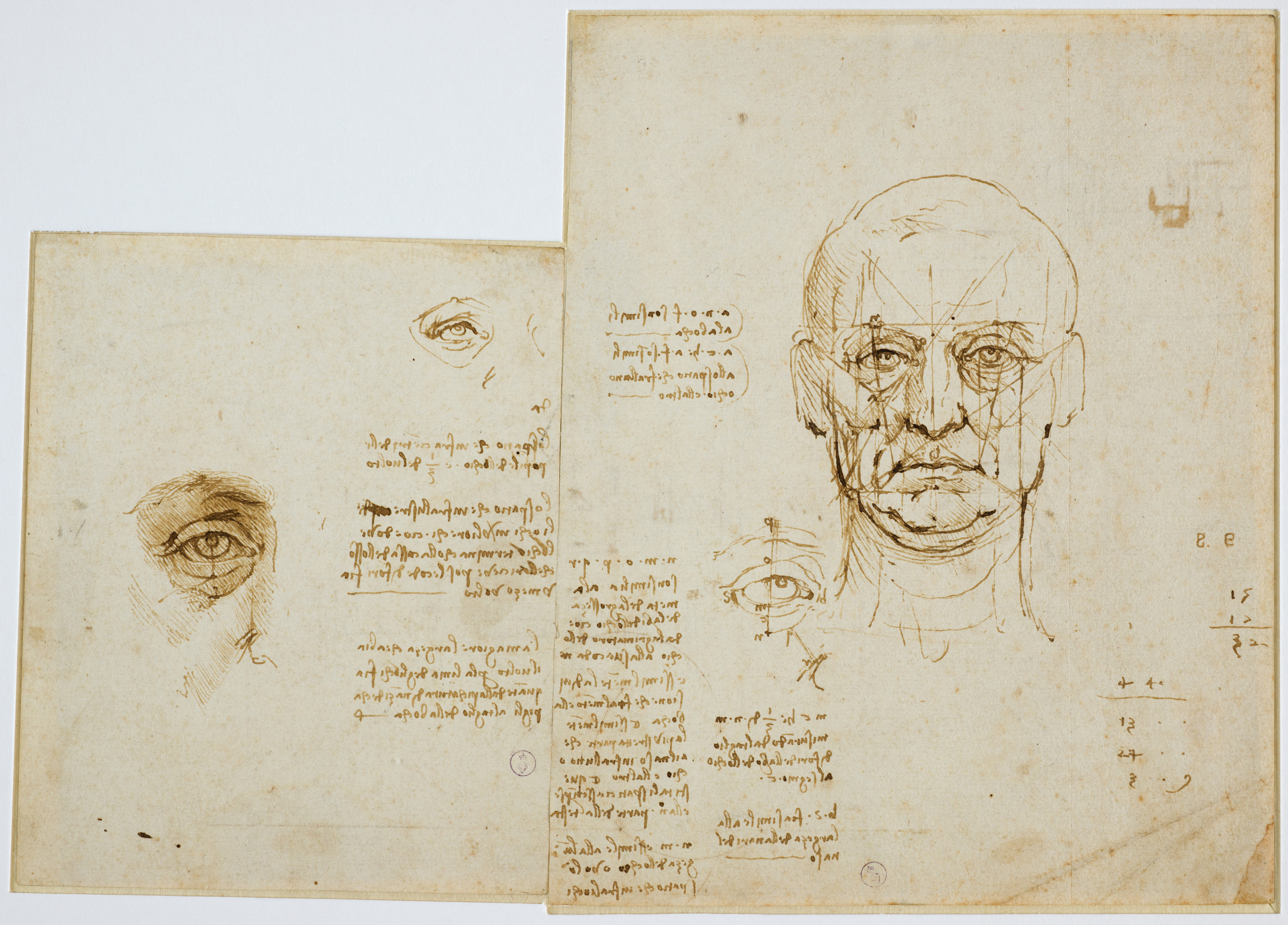
Studies of proportions of face and eye (with notes) by Leonardo da Vinci, circa 1489. By Permission of MiC-Musei Reali. Biblioteca Reale. Photo: Ernani Orcorte.
Bravo to the Burns team and most especially to Buddy Squires, who bumps his cinematography up a notch utilizing split screen images (for the first time in a Ken Burns film!) to juxtapose comparable vintage and current film and photographic images with pages from Leonardo’s notebooks. The latter include a rich array of preliminary “cartoon” renderings for his paintings; detailed movement, light, shade and perspective studies of horses, birds, candle flames, folds of cloth and natural landscapes; handwritten (backwards aka “mirror script”!) scientific analyses and analytical drawings of such inventions as flying machines and the intricacies of human anatomy culled directly from his human and animal cadaver dissections. In this way, the film transcends Leonardo’s timeline, linking his artistic and scientific explorations to those well beyond the 15th and 16th centuries.

Drawing of a fetus in utero, with the uterus opened out; details of the placenta and uterus by Leonardo da Vinci, circa 1511. Royal Collection Trust/©His Majesty King Charles III.
“Leonardo’s thinking was so unique and, in many ways, timeless that our traditional approach alone would have been insufficient,” said writer/director David McMahon. “Though we follow Leonardo’s personal journey and explore his artistic and scientific accomplishments, we’re also really focused on what went on in his mind and on understanding the depths of his curiosity. To do this we use material from his notebooks mixed with archival film, photos and sound, along with our cinematography and visual effects, and we’re not afraid to stray from the timeline.”
Leonardo da Vinci, illegitimate and unschooled, transformed his humble beginnings into a teachable landscape that fed his voracious desire to learn, to connect, to see and create things anew. A lifelong perfectionist, he was the recipient of many artistic commissions from avid patrons; but he rarely completed anything, at least to his satisfaction, and often carried his unfinished paintings around for years.

Drawings of a whole heart by Leonardo da Vinci, probably of an ox, three diagrams demonstrating the function of the ventricles, circa 1511-1513. Royal Collection Trust/Royal Collection Trust/©His Majesty King Charles III.
Seasoned historians, biographers, museum curators, theater and film directors, a priest and a surgeon are threaded throughout the four hour film. Some are subtitled and all make a solid case for Leonardo’s genius… as a “shape shifter,” who “never took no for an answer,” who “always wanted to know more,” and who had an “incredible investigative ability to make his eye an investigative tool.”
“You must wander around and constantly, as you go, observe, note and consider the circumstances and behavior of men as they talk, quarrel, laugh or fight together,” wrote Leonardo da Vinci. Italian actor Adriano Giannini gives voice to Leonardo’s writings throughout the film.

“Mona Lisa” by Leonardo da Vinci, circa 1503. RMN-Grand Palais/Art Resource, NY.
Despite having been a serious student of Art History, I can’t say that I ever understood the appeal of the “Mona Lisa.” It was too distancing and enigmatic a portrait for my taste.
I can now look at the painting with fresh eyes and appreciate it most especially for Leonardo’s rich and ebullient backstory and the passion that drove him to meld multiple disciplines into his work as an artist and scientist. I encourage you not to miss Ken Burns, Sarah Burns and David McMahon’s dazzling new film, Leonardo da Vinci. I guarantee there’s no better way to time travel back to the Italian Renaissance and put the present day in perspective. –Judith Trojan
Viewing LEONARDO DA VINCI

“Virgin and Child with Saint Anne” by Leonardo da Vinci, circa 1503. Post-restoration 2012. The stripes on left and right are 19th century additions left for documentation purpose. This painting was begun around 1503 at least, in Florence, then was kept by Leonardo da Vinci until his death, still unfinished in 1519; the work was very probably acquired by Francis I in 1518. Musee du Louvre via Art Resource.
Part 1: The Disciple of Experience premieres on PBS tonight, Monday, November 18, 2024, 8:00 – 10:00 p.m. ET/7:00 C.
Part 2: Painter-God debuts on PBS on Tuesday, November 19, 2024, 8:00 – 10:00 p.m. ET/7:00 C.
Check local listings for air times and repeat broadcasts in your region. The two-part series will be available to stream on all station-branded PBS platforms, including PBS.org and the PBS Video App , via iOS, Android, Roku, Apple TV, Amazon Fire TV, Android TV, Samsung Smart TV, Chromecast and VIZIO. PBS station members can also view Leonardo da Vinci via PBS Passport, as part of a full collection of Ken Burns’ films. International distribution will be handled by PBS International. Visit ShopPBS.org for DVD purchase.
In tandem with the broadcast of Leonardo da Vinci, middle and high school educators will be able to tap into theme-related educational materials (videos, topical research and other classroom supplements geared specifically for grades 6-8 and 9-12) at the Ken Burns in the Classroom site on PBS Learning Media to enrich their Italian Renaissance classes in Social Studies, Art History, Literature, Science and Biology. –Judith Trojan

“The Last Supper” by Leonardo da Vinci, circa 1494-1498. Mural, fresco in the Refectory of Santa Maria della Grazie, a Dominican Convent in Milan, Italy.
Discover more from FrontRowCenter
Subscribe to get the latest posts sent to your email.


 FrontRowCenter